
Concentration is key to slashing the carbon footprint of coconut water while keeping water in the local watershed
With the global market for coconut water estimated to be worth USD 2.84 billion in 2024, rising to USD 4.73 billion by 2029, this thirst-quenching drink remains ever-popular with today’s health-conscious consumers.
DATE 2024-09-20
For one coconut processor in the Philippines, the challenge has been how to capitalize on this rising consumer demand while also meeting growing expectations for more efficient and responsible food production.
The task for the coconut producer has been threefold: reducing costs, streamlining the logistics involved in transporting large volumes of liquid around the world, and optimizing water use throughout the production process.
Every part of a coconut is useful. The husk becomes coir or rope, the shell can be used for fuel and charcoal, and the testa is a source of oil. The meat and milk provide nutritious food, while the remaining material can be processed into low-fat desiccated coconut powder. Even coconut water, once considered difficult to handle and often discarded as waste, has significant potential thanks to its carbohydrates and electrolytes such as potassium, sodium and magnesium. Yet many desiccated coconut manufacturers are still unaware of this opportunity.
Until recent years, only the water from green coconuts reached the market as a fresh product. The water from mature coconuts was thrown away as a by-product in the production of nata d coco and cake, and it was used to produce desiccated coconut destined for the bakery and confectionary industries. In the mid-2000s, however, consumer demand led coconut processing companies, including the one in question, to reassess the value of this previous waste product.
The challenge
Founded in the 1940s to supply desiccated coconut to a US-based chocolate bar manufacturer, the company’s integrated coconut processing plant near Manila stands amid sprawling coconut plantations. These plantations provide the raw materials for a wide variety of coconut products, including coconut water.
The challenge for the company, and for other coconut processors, has been how to profitably produce and transport in-demand coconut water from remote corners of the Philippines, Indonesia, Brazil, Sri Lanka, India, Malaysia and Thailand to millions of consumers thousands of kilometres away.
The solution
For the company in question, the solution has been the incorporation of Alfa Laval’s AlfaVap evaporation system into the production line at its plant, which processes 300,000 coconuts a day. The 90,000 litres of coconut water produced each day is concentrated to just 6,000 litres, generating significant savings in packaging and transport costs while also reducing the associated carbon footprint.
As an early adopter of this processing method, the company now supplies a major global beverage company with coconut water concentrate.
The costs to pack and transport large volumes of coconut water are huge, so we suggested that the customer produce coconut water concentrate. This costs less to package and ship to destinations around the world where it is reconstituted, repackaged for retail and sold,” explains Dharmendra Shukla, Regional Market Manager. “Normally, with concentrate, a lot of vitamins and nutrients are lost, but the AlfaVap technology is designed with minimal impact on the reconstituted product quality. It is low-temperature evaporation, with the final product coming out at 45-48°C once through technology, so the nutrient levels and the colour are minimally affected.”
By recovering 84,000 litres of water every day, AlfaVap technology also reduces the load on the plant’s wastewater treatment facility. The lower effluent volume helps ease treatment requirements, while the clean condensate from the evaporator can potentially be reused for cleaning or safely discharged with minimal treatment.
Processing the coconut water has dramatically reduced the amount of water going to the wastewater treatment plant,” says Dharmendra. “The customer has cut their wastewater treatment costs and is also making money from a by-product that was previously wasted.”
The challenge
Founded in the 1940s to supply desiccated coconut to a US-based chocolate bar manufacturer, the company’s integrated coconut processing plant near Manila stands amid sprawling coconut plantations. These plantations provide the raw materials for a wide variety of coconut products, including coconut water.
The challenge for the company, and for other coconut processors, has been how to profitably produce and transport in-demand coconut water from remote corners of the Philippines, Indonesia, Brazil, Sri Lanka, India, Malaysia and Thailand to millions of consumers thousands of kilometres away.
The solution
For the company in question, the solution has been the incorporation of Alfa Laval’s AlfaVap evaporation system into the production line at its plant, which processes 300,000 coconuts a day. The 90,000 litres of coconut water produced each day is concentrated to just 6,000 litres, generating significant savings in packaging and transport costs while also reducing the associated carbon footprint.
As an early adopter of this processing method, the company now supplies a major global beverage company with coconut water concentrate.
The costs to pack and transport large volumes of coconut water are huge, so we suggested that the customer produce coconut water concentrate. This costs less to package and ship to destinations around the world where it is reconstituted, repackaged for retail and sold,” explains Dharmendra Shukla, Regional Market Manager. “Normally, with concentrate, a lot of vitamins and nutrients are lost, but the AlfaVap technology is designed with minimal impact on the reconstituted product quality. It is low-temperature evaporation, with the final product coming out at 45-48°C once through technology, so the nutrient levels and the colour are minimally affected.”
By recovering 84,000 litres of water every day, AlfaVap technology also reduces the load on the plant’s wastewater treatment facility. The lower effluent volume helps ease treatment requirements, while the clean condensate from the evaporator can potentially be reused for cleaning or safely discharged with minimal treatment.
Processing the coconut water has dramatically reduced the amount of water going to the wastewater treatment plant,” says Dharmendra. “The customer has cut their wastewater treatment costs and is also making money from a by-product that was previously wasted.”
Highlighted technologies
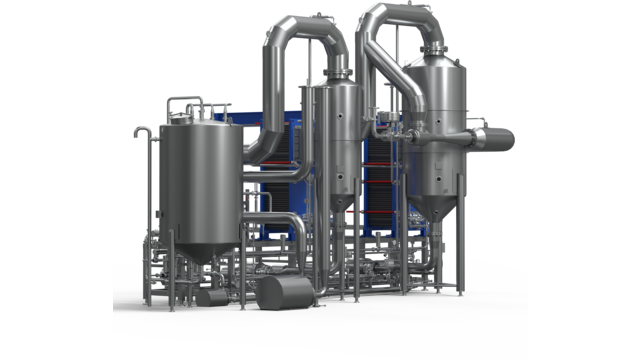

A 93% reduction in coconut water volume means less product to transport, significantly reducing the carbon emissions associated with shipping it over thousands of kilometres.

84,000 litres of water are recovered daily as condensate, which can potentially be reused for cleaning or safely discharged into local watersheds with minimal treatment.